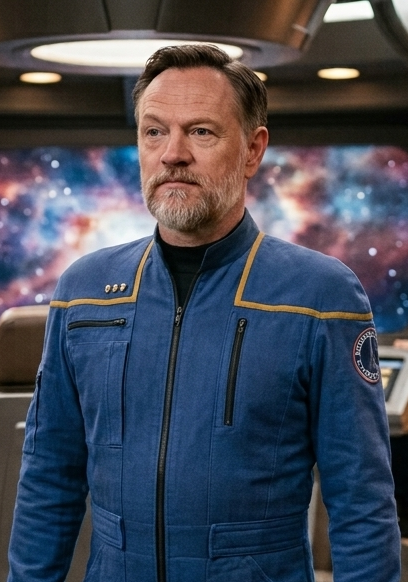
Captain Percival "Percy" Tapper
Name Percival "Percy" Nathaniel Tapper
Position Commanding Officer
Rank Captain
Character Information
| Gender | Male | |
| Species | Human | |
| Age | 47 |
Physical Appearance
| Height | 6'1" / 185cm | |
| Weight | 174 lbs / 79 kg | |
| Hair Color | Dark Brown / Grey | |
| Eye Color | Blue-Grey | |
| Physical Description | Percival "Percy" Tapper stands just over six feet in height, broad through the shoulders and solidly built from years spent carrying excavation equipment over uneven ground rather than time in a gymnasium. His bearing is relaxed, almost understated, and first impressions often place him among the sciences before anyone notices the pips on his collar. His hair is dark brown, now beginning to grey at the temples, and kept short with little concern for fashion. A neatly trimmed beard frames a face more accustomed to listening than speaking. Blue-grey eyes seldom linger in one place for long. They drift naturally toward details before they decide whether to voice a concern. Colleagues have learned that Tapper notices far more than he comments on. His voice carries traces of his Newfoundland upbringing, softened by years of service among crews drawn from all corners of the Federation. The accent has mellowed with time, but it returns around old friends, during long conversations over tea, or whenever he finds himself back on the rocky shores where he was raised. Tapper's uniforms are invariably neat without appearing meticulous. Off-duty, he favours practical clothing suited to laboratories, archives, and archaeological sites, places where his own curiosity has a habit of leading him. |
Family
| Spouse | Claire Whitaker, MD (previously engaged) | |
| Children | Evelyn "Evie" Tapper (deceased) | |
| Father | Gerald Tapper (retired Harbour Master) | |
| Mother | Mary Howlett (retired schoolteacher) | |
| Sister(s) | Laura Tapper (Marine Biologist / Baccalieu Island Ecological Reserve Director) |
Personality & Traits
| General Overview | Those who serve with Percy soon recognize that he possesses an unusual stillness. He seldom interrupts, seldom fills silence for its own sake, and he rarely raises his voice. People often leave a conversation with him surprised by how much they have said. He has a way of asking one single thoughtful question, then giving the answer all the time it requires. An anthropologist by training and temperament, Percy approaches people with the same patience he brings to ancient civilizations and unfamiliar worlds. He is naturally curious, not only about cultures and histories, but about the individuals who create them. A new tradition, an unfamiliar expression, or a personal story rarely passes without earning his interest. His curiosity is not a performance; it is simply the way he engages with the universe. As a commanding officer, Percy favours understanding before judgment. He believes mistakes are best examined before they are punished, and that knowing why something happened is often the first step toward preventing it from happening again. This does not make him indecisive or permissive. Once he has reached a conclusion, he is capable of acting with considerable resolve. His authority comes less from force of personality than from the confidence his crew places in his thoughtfulness and fairness. Perhaps Percy's greatest strength is also his greatest weakness. He has an almost instinctive need to understand the unknown. A damaged artifact, a contradictory historical record, or an unexplained phenomenon can occupy his thoughts long after everyone else has moved on. This quality has led to some of his greatest discoveries, but it has also occasionally placed him and those around him in difficult situations. He has spent a lifetime learning that curiosity can open doors and he continues to discover that some doors are best approached with caution. |
|
| Strengths & Weaknesses | Strengths • Exceptional cultural awareness and diplomatic intuition. • Patient and attentive listener with a talent for understanding differing perspectives. • Strong investigative instincts and an ability to identify patterns in incomplete information. • Encourages growth in others and recognizes potential in those who may overlook it themselves. • Calm under pressure, particularly in unfamiliar environments. • Willingness to admit uncertainty and seek answers rather than assume them. Weaknesses • Difficulty abandoning unanswered questions, even when practical concerns suggest caution. • Can become so focused on a mystery or research problem that he loses sight of time and personal needs. • Occasionally assumes that patience and understanding can resolve conflicts that require firmer intervention. • Carries a quiet tendency to revisit past decisions, particularly those involving lives placed under his command. • More comfortable studying a problem than accepting that some problems have no satisfying solution. |
|
| Ambitions | Percy has never been motivated by rank for its own sake. His career has been shaped by a desire to understand the people and civilizations he has encountered, preserving knowledge that might otherwise disappear. As commanding officer of the USS Eventide, his ambition is not to leave behind a legacy of conquest or exploration records. He hopes to lead a crew capable of approaching the unknown with humility, curiosity, and respect. He considers every world visited and every culture encountered a conversation rather than an acquisition. On a personal level, Percy continues to seek a better understanding of the universe and his place within it. The questions that remain unanswered have always been the ones that keep him moving forward. |
|
| Hobbies & Interests | Outside of his professional duties, Percy maintains a wide range of interests shaped by his lifelong fascination with history and culture. He is an avid reader, with particular interests in anthropology, archaeology, linguistics, and comparative mythology. He spends late hours reviewing excavation reports or historical accounts over a cup of tea--a habit his colleagues have come to see as both endearing and difficult to interrupt. Percy enjoys traditional music, coastal history, and the preservation of oral traditions. He maintains an interest in the maritime heritage of Newfoundland, frequently returning to the stories and practices of the communities that shaped him in his youth. He also enjoys gardening, an interest inherited from his mother, and finds the patience required to cultivate living things a welcome change-of-pace to the steady beat of Starfleet service. Percy maintains a modest collection of wines and spirits. |
| Personal History | Percival Nathaniel Tapper was born in the coastal community of Bay de Verde, Newfoundland, the second child of Gerald and Mary (nee Howlett) Tapper. His father served for many years as harbour master, while his mother taught at the local elementary school. Home was a place where practical knowledge and curiosity weighed the same. Gerald could identify a vessel by its silhouette on the horizon before it reached the harbour, and Mary believed there was scarcely a question that could not be improved by reading one more book. Percy spent much of his childhood outdoors. The shoreline became both playground and classroom, offering tide pools, weathered foundations, forgotten fishing stages, and objects whose stories had outlived the people who left them behind. While other children were content to discover something unusual, Percy wanted to know where it had come from, who had made it, and what had become of them. His older sister, Laura, learned quickly that any walk with her younger brother might become an unexpected detour if he found something that forced another question. His fascination with history matured into a fascination with people. As he grew older, he found himself drawn less to dates and events than to the lives hidden just behind them. Languages, customs, traditions, and beliefs became a means of understanding how communities endured, adapted, and remembered. By the time he completed secondary school, he had already decided that he wanted to study anthropology, though he had not yet imagined that the path would eventually lead him into Starfleet. Upon completing secondary school, Tapper accepted admission to the University of Cape Town, where he pursued a dual degree in anthropology and archaeology. Four years of study carried him far from the fishing communities of Newfoundland and immersed him in one of Earth's richest academic environments. Classroom instruction was balanced by fieldwork, archival research, and archaeological excavations, experiences that confirmed his conviction that understanding a culture required equal doses of patience, humility, and a willingness to let the record speak before personal assumptions. He graduated in 2156 with a Bachelor of Arts in Anthropology and Archaeology. With his academic foundation firmly established, Percy sought a career that would place him at the meeting point of scholarship and exploration. Starfleet offered opportunities no university could match: newly contacted civilizations, unexplored worlds, and the chance to see them first-hand. He entered United Earth Starfleet Academy in 2156, bringing with him a perspective shaped as much by excavation trenches and research libraries as by his burgeoning curiosity about people. During his early career, his work frequently placed him alongside civilian researchers, diplomats, professors, and scientific specialists. It was through one such collaboration that he met Dr. Claire Whitaker, a physician whose curiosity matched his own, even if it was directed toward very different questions. Their relationship grew gradually and they shared a mutual appreciation for academia. They eventually chose to build a life together and, in 2169, welcomed a daughter, Evelyn, whom everyone simply called "Evie". Fatherhood reshaped Percy's understanding of the passage of time in ways no archaeological dig ever had. The future became far more tangible than the past. He still accepted assignments that took him across the Federation, but with every return home there carried a significance that surprised him. Evie inherited her father's habit of asking endless questions, and Percy answered as many as he could, finding out first-hand that children get to the heart of a problem faster than adults. When Evie became seriously ill, Percy and Claire pursued every treatment available to them. The prognosis offered some hope, and together they made each decision believing they were giving their daughter the best chance possible. Her death changed neither of them into different people, but it did alter the lives they had built together. Grief became a constant and uninvited companion for both of them, and over time they came to understand that love alone could not see them through as husband and wife. They parted with affection and respect, remaining part of one another's lives through shared memories instead of a shared home. Those who knew Percy before and after that bittersweet chapter often remark that he became more introspective, though never totally withdrawn. If anything, the experience deepened the patience and compassion that had always been native to his character. It also left him with an enduring appreciation for the universe's questions that can't be answered perfectly. He continued to believe that understanding was something worth pursuing, even while coming to accept that some mysteries remain beyond resolution. Following the death of his daughter and the end of his relationship with Claire, he returned to active service, though he found himself increasingly drawn away from the routine of life aboard starships. While his work remained highly-regarded, he accepted a temporary leave of absence to participate in a civilian archaeological expedition, intending to spend several months in the field before returning to Starfleet. One excavation became another, and the leave gradually evolved into a two-year sabbatical devoted to archaeological and anthropological research across several worlds. By the time Starfleet recalled him to Earth, Percy had begun to imagine that this chapter of his life might continue indefinitely. He remained a commissioned officer, though one who had grown accustomed to canvas tents, excavation journals, and sunburns. The prospect of returning to starship duty held little appeal, and the offer of command came as a genuine surprise. It was only after learning the purpose behind the USS Eventide that his hesitation began to fade. Designed for long-range exploration during a period when the young Federation was still finding its place among the stars, the vessel represented something different from the assignments he had left behind. Eventide would seek understanding before exploitation, conversation before assumption, and discovery that would be measured as much by the cultures it encountered as the worlds it surveyed. For the first time in years, this felt less like a promotion and more like a continuation of the questions he'd been asking his entire life. |
|
| Service Record | 2134: Percy Nathaniel Tapper born in Bay de Verde, Newfoundland, Earth. 2152-2156: Studies and graduates with a dual degree in anthropology and archaeology from the University of Cape Town. 2156-2160: Continues his studies at United Earth Starfleet Academy, graduating with a focus in comparative linguistics, diplomacy, history, and command. Given commission as Ensign. 2160-2162: Serves aboard the USS Kiawah (Daedalus-class), as a science officer. 2162-2165: Serves aboard the USS Spetsai (Freedom-class), as a science officer. Promoted to Lieutenant Junior Grade. 2165-2168: Returns to Earth and assigned to the newly-created Office of Science & Research. Promoted to Lieutenant. 2168-2172: Serves aboard the USS Ningbo (Sarajevo-class), as Chief Science Officer. Promoted to Lieutenant Commander. 2172-2175: Serves aboard the USS Repulse (NX-class refit), as First Officer and Chief Science Officer. Promoted to Commander. 2175-2178: Returns to Earth, teaching science courses at Starfleet Academy. 2178-2181: Takes temporary leave which turns into a nearly three-year sabbatical. 2181-present: Assumes command of USS Eventide (Bonaventure-class Mk II). |